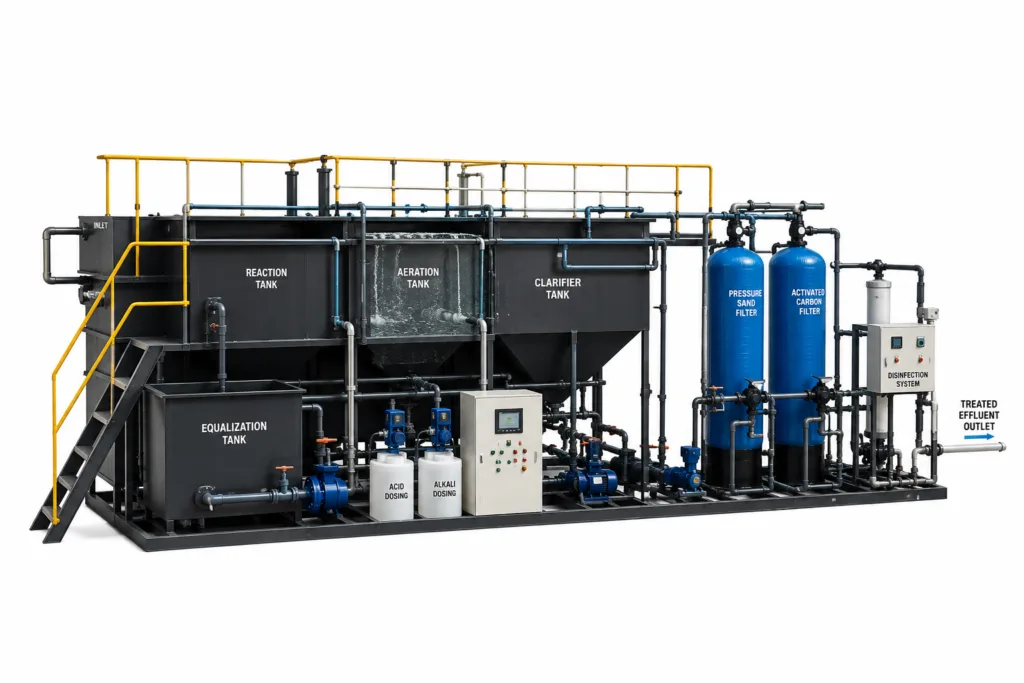
Effluent Treatment Plants (ETPs) are advanced wastewater treatment systems designed to treat industrial effluents by removing physical, chemical, and biological contaminants before the treated water is safely discharged or reused. These systems help industries comply with environmental regulations while minimizing the impact of wastewater on natural resources.
ETPs are customized based on the type of industry, wastewater characteristics, and discharge requirements, making them an essential solution for sustainable industrial water management.
How an Effluent Treatment Plant Works
Industrial wastewater passes through a series of treatment stages to remove contaminants and improve water quality.
The treatment process typically includes:
- Screening removes large solids, debris, and floating materials.
- Equalization Tank balances the flow and quality of incoming wastewater.
- pH Correction adjusts the acidity or alkalinity of the wastewater for effective treatment.
- Coagulation and Flocculation use treatment chemicals to combine fine suspended particles into larger flocs.
- Primary Clarification separates suspended solids from the wastewater.
- Biological Treatment removes dissolved organic pollutants using beneficial microorganisms where applicable.
- Secondary Clarification separates biological sludge from treated water.
- Advanced Filtration and Disinfection (Optional) using pressure filters, activated carbon filters, UV, or other technologies for improved water quality.
- Sludge Handling thickens, dewaters, and prepares sludge for safe disposal or further processing.
Key Features
- Efficient treatment of industrial wastewater
- Removes suspended solids, oils, organic matter, chemicals, and other contaminants
- Custom-designed for different industrial applications
- Robust and durable construction
- Automatic or semi-automatic operation
- Energy-efficient and reliable performance
- Low maintenance requirements
- Scalable designs for varying treatment capacities
- Supports water reuse and recycling initiatives
- Designed to help meet applicable environmental discharge standards
Benefits
- Reduces environmental pollution and protects natural water bodies
- Helps industries comply with wastewater discharge regulations
- Supports water recycling and conservation
- Reduces freshwater consumption through treated water reuse where appropriate
- Improves operational sustainability
- Protects downstream equipment and infrastructure
- Cost-effective solution for long-term industrial wastewater management
- Enhances corporate environmental responsibility
Applications
Effluent Treatment Plants are widely used in:
- Food and beverage industries
- Textile and garment manufacturing
- Pharmaceutical industries
- Chemical processing plants
- Electroplating and metal finishing industries
- Paper and pulp mills
- Paint and coating industries
- Dairy and beverage processing units
- Automobile manufacturing facilities
- Printing and packaging industries
- Engineering and manufacturing plants
- Industrial estates and production facilities
Why Choose an Effluent Treatment Plant?
An Effluent Treatment Plant is a reliable and sustainable solution for managing industrial wastewater. By effectively removing contaminants and improving water quality, it helps industries protect the environment, meet regulatory requirements, and reduce water consumption through reuse opportunities. Designed for efficiency, durability, and long-term performance, ETPs play a vital role in responsible industrial operations and sustainable water management.