Conventional Sewage Treatment Plants (STPs) are engineered systems designed to treat domestic and commercial wastewater by removing suspended solids, organic matter, nutrients, and harmful microorganisms before the treated water is safely discharged or reused. These plants utilize a combination of physical, biological, and chemical treatment processes to produce treated water that meets applicable environmental standards.
Conventional STPs are widely used in residential communities, commercial buildings, institutions, hotels, hospitals, and industrial facilities, providing a reliable and sustainable solution for wastewater management.
How a Conventional Sewage Treatment Plant Works
Wastewater passes through multiple treatment stages to remove contaminants and improve water quality.
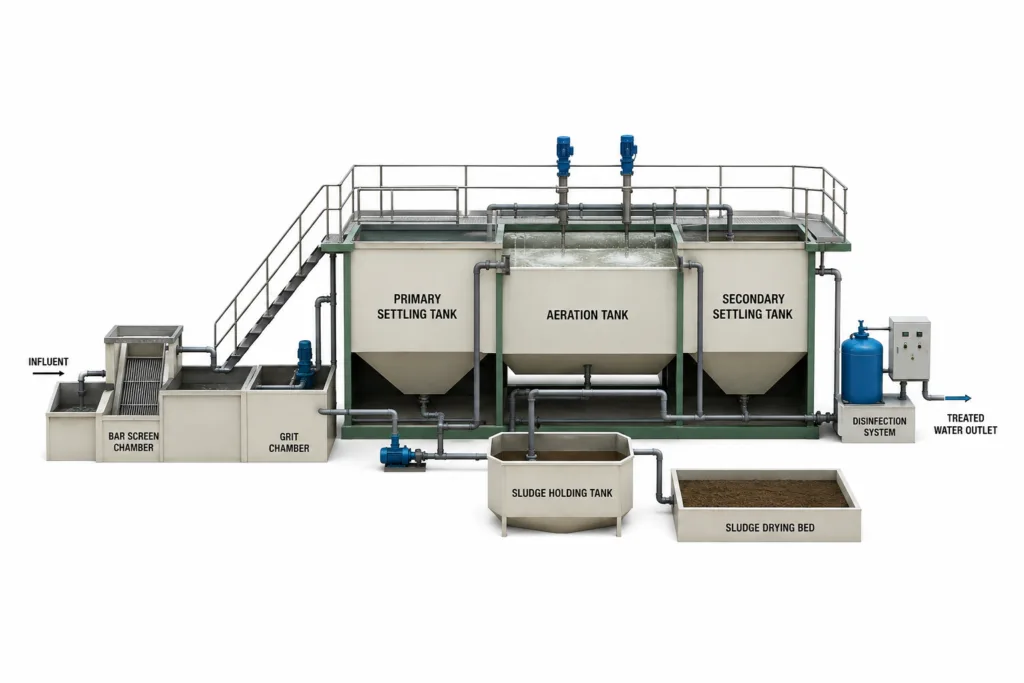
The treatment process typically includes:
- Screening removes large debris such as plastics, paper, and other solid waste.
- Grit Removal separates sand, gravel, and other heavy inorganic particles.
- Primary Sedimentation allows suspended solids to settle, reducing the organic load.
- Biological Treatment uses naturally occurring microorganisms to break down dissolved organic matter through processes such as the Activated Sludge Process (ASP).
- Secondary Clarification separates treated water from biological sludge.
- Disinfection using chlorine, UV, or other approved methods reduces harmful microorganisms before discharge or reuse.
- Sludge Handling thickens and dewaters sludge for safe disposal or further treatment.
Key Features
- Efficient removal of organic pollutants and suspended solids
- Proven and reliable treatment technology
- Suitable for continuous, high-volume wastewater treatment
- Durable construction for long-term operation
- Custom-designed based on wastewater flow and quality
- Automatic or semi-automatic operation options
- Energy-efficient equipment and process control
- Low maintenance with dependable performance
- Capable of producing treated water suitable for non-potable reuse, subject to local regulations and system design
Benefits
- Reduces environmental pollution by treating wastewater effectively
- Supports water conservation through treated water reuse where permitted
- Helps meet regulatory wastewater discharge requirements
- Minimizes unpleasant odours and improves sanitation
- Protects public health and surrounding ecosystems
- Reduces dependence on fresh water for landscaping and utility applications
- Designed for reliable, long-term operation with cost-effective performance
Applications
Conventional STPs are suitable for:
- Residential apartments and housing societies
- Villas and gated communities
- Hotels and resorts
- Hospitals and healthcare facilities
- Educational institutions
- Office buildings and commercial complexes
- Shopping malls
- Industrial campuses
- Government buildings
- Airports and transportation hubs
- Townships and mixed-use developments
Why Choose a Conventional Sewage Treatment Plant?
A conventional sewage treatment plant offers a dependable and efficient solution for managing wastewater while supporting environmental sustainability. By combining established treatment technologies with robust engineering, these systems help reduce pollution, conserve water through reuse opportunities, and ensure long-term operational reliability. Whether for residential, commercial, or institutional applications, a conventional STP is an effective investment in responsible wastewater management.